
The Art of the Coffee Blend: Creating Your Own Signature Flavor
You can craft a truly unique coffee blend by understanding how bean origins shape flavor—like Ethiopian citrus brightness or Colombian chocolate richness—and mastering roast profiles that highlight those nuances. Experiment with bean ratios to balance acidity, body, and sweetness, creating harmony in every cup. Pay attention to tasting notes to fine-tune your signature flavor. With patience and creativity, you’ll transform ordinary beans into a fascinating blend that tells your story. Explore the steps to perfect your craft.
Understanding Coffee Bean Origins

Although you might not always consider it, the origin of coffee beans plays an essential role in shaping the flavor profile of your blend. When you explore single origin coffees, you reveal distinct flavor nuances unique to their terroir—altitude, soil, and climate all contribute to the bean’s character. By understanding these origins, you gain the freedom to craft blends that express complexity and balance, highlighting bright citrus notes from Ethiopian beans or rich chocolate undertones from Colombian varieties. This knowledge empowers you to move beyond generic blends and create a signature coffee that resonates with your palate’s desire for authenticity and adventure. Embracing the story behind each bean enriches your blending experience, transforming it into a passionate journey where flavor meets your quest for freedom.
Exploring Roast Profiles and Their Impact
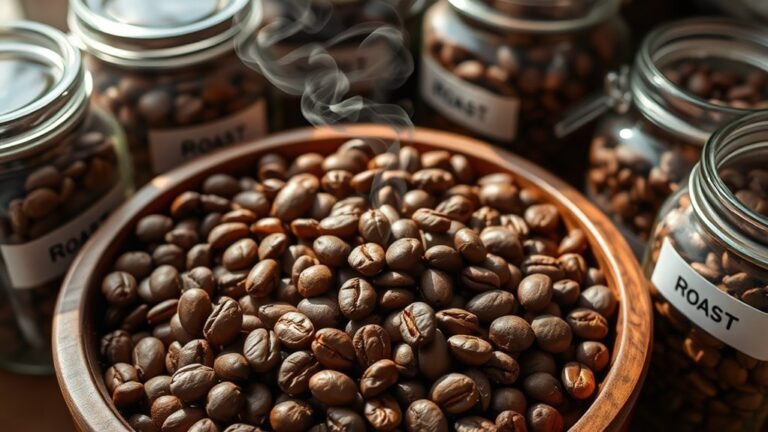
You’ve probably noticed how light roasts preserve bright, fruity notes while dark roasts bring out deep, smoky flavors. As beans roast, their chemical makeup transforms, revealing a spectrum of tastes that can redefine your blend. Understanding these changes lets you craft a profile that highlights the best qualities of each bean.
Light vs. Dark Roasts
When you explore the world of coffee roasting, understanding the difference between light and dark roasts is essential to appreciating how flavor profiles develop. Light roast benefits include preserving the bean’s original nuances—bright acidity, floral or fruity notes—that let you experience coffee’s true origin. You’ll notice a lighter body and a crisp, vibrant cup that feels almost liberating. On the other hand, dark roast intensity transforms the bean through deeper caramelization and smoky undertones, delivering a bold, robust flavor with a heavier body. This intensity can add depth and strength to your blends, perfect if you crave a powerful, assertive brew. By mastering these contrasts, you gain freedom to craft blends that speak uniquely to your taste, balancing brightness and strength as you desire.
Flavor Changes During Roasting
As coffee beans roast, their flavors undergo a remarkable transformation that shapes the final cup you savor. You’ll notice that adjusting the roasting temperature directly influences flavor development—lower temperatures preserve bright, acidic notes, while higher temperatures deepen body and bring out bittersweet, smoky nuances. The Maillard reaction and caramelization activate at precise moments, revealing complex sugars and aromatic oils. By mastering these roast profiles, you can craft blends that highlight desired characteristics, whether it’s vibrant fruitiness or rich chocolate undertones. Understanding how flavor evolves during roasting empowers you to break free from convention, creating a signature blend that truly reflects your taste and spirit. Embrace this dynamic process, and you’ll find endless freedom in the art of coffee blending.
Tasting Notes and Flavor Characteristics
A symphony of flavors unfolds with every sip of a carefully crafted coffee blend, inviting you to explore its complex tasting notes and unique flavor characteristics. When you develop your blend, you’re creating tasting profiles that reveal subtle flavor nuances—like hints of citrus, chocolate, or floral aromas—that dance on your palate. Understanding these layers allows you to tailor the blend’s body, acidity, and sweetness, giving you the freedom to express your personal taste. Each note contributes to a harmonious experience, where brightness balances richness and aftertaste lingers with intention. Embrace this sensory journey; your blend becomes not just a drink but a signature flavor story, crafted with precision and passion that sets your coffee apart.
Selecting Beans for Your Blend
Although crafting the perfect blend starts with envisioning its flavor, selecting the right beans is where your vision takes tangible form. You’ll want to explore diverse bean varieties, each offering unique flavor profiles that set the stage for your signature blend. Consider how origin, processing, and roast level influence acidity, body, and aroma. This thoughtful selection empowers you to capture freedom in every cup.
| Bean Variety | Flavor Profile | Origin |
|---|---|---|
| Ethiopian | Floral, Citrus | Africa |
| Colombian | Nutty, Balanced | South America |
| Sumatran | Earthy, Full-bodied | Asia |
Choose beans that resonate with your desired expression, and you’ll craft a blend that’s truly yours.
Experimenting With Bean Ratios

Once you’ve selected your beans, the real art begins in balancing their proportions. Experimenting with bean ratios is where your blend finds its soul. You’ll want to start small—try varying percentages to see how each bean’s character shines or harmonizes. Maybe a 70:30 split brings out brightness while a 50:50 reveals complexity. Don’t hesitate to push boundaries; blend experimentation is your playground. Keep detailed notes on each trial to track how slight shifts affect aroma, body, and flavor. This freedom to tweak empowers you to craft a signature profile that’s uniquely yours. Remember, bean ratios aren’t just numbers—they’re the dialogue between beans that shapes every sip. Embrace this process with curiosity, and your blend will tell your story in every cup.
Grinding and Brewing Considerations
How finely you grind your coffee can make or break the final cup. Matching grind size to your brew method guarantees ideal extraction time and flavor balance. Here’s what to take into account:
- Grind uniformity: Consistent particle size prevents over- or under-extraction, preserving your blend’s intended profile.
- Brew ratio and water temperature: Adjust these alongside grind size to release the fullest flavor without bitterness or sourness.
- Brewing equipment: Your tools dictate the ideal grind; espresso demands fine grounds, while French press prefers coarse.
Storing Your Custom Blend for Freshness
Because preserving your blend’s freshness is essential to releasing its full flavor potential, proper storage is a skill every coffee enthusiast should master. You want to lock in those complex aromas and vibrant notes, and that starts with eliminating air exposure. Vacuum sealing your custom blend is one of the best ways to achieve this, as it removes oxygen that accelerates staling. If vacuum sealing isn’t an option, airtight containers made from opaque materials will do the trick, shielding your coffee from light and moisture. Keep your blend in a cool, dark place—avoid heat and humidity, which degrade flavor. By mastering these storage techniques, you maintain the freedom to enjoy your signature coffee at its freshest, savoring every bold and nuanced sip exactly as you crafted it.
Troubleshooting Common Blending Challenges

When your blend hits a sour note or tastes flat, it’s essential to pinpoint those off-flavors quickly. You’ll need to balance bean profiles carefully, ensuring each variety complements the others without overpowering. Sometimes, adjusting roast levels is the key to releasing harmony and bringing your blend to life.
Identifying Off-Flavors
Why do some coffee blends fall short of perfection despite careful selection? It often comes down to off flavor identification through rigorous sensory evaluation. You’ve got to trust your palate as much as your process. When tasting, watch for:
- Unpleasant acidity — a sharp, sour bite that overwhelms.
- Musty or moldy notes — signs of poor storage or stale beans.
- Bitter or ashy flavors — often from over-roasting or defective beans.
Pinpointing these off-flavors is your first step to freedom in blending. By refining your sensory evaluation skills, you free yourself from guesswork, enabling you to craft blends that truly sing. Remember, every flaw you detect is a clue guiding you to your signature flavor, not a failure.
Balancing Bean Profiles
Three core challenges often trip up even seasoned blenders: achieving harmony between acidity, body, and flavor complexity; managing roast level contrasts; and ensuring consistency across batches. When balancing bean profiles, your goal is to cultivate true bean harmony, where each variety’s unique character complements rather than competes. You’ll want to focus on profile synergy—how acidity from one bean interacts with the body of another, creating a seamless experience. If the blend feels disjointed or one note overpowers, tweak proportions or swap components to restore balance. Remember, it’s a delicate dance. Embrace experimentation with intention, trusting your palate to guide you toward a blend that liberates your creativity and honors each bean’s potential. This pursuit transforms ordinary mixtures into signature masterpieces.
Adjusting Roast Levels
Mastering bean harmony is only part of the equation; adjusting roast levels takes your blend from balanced to brilliant. You’ll find that tweaking roast timing and roast development reveals new flavor dimensions and resolves blending issues seamlessly. Here’s how to elevate your craft:
- Fine-tune roast timing: Shorten or extend it to highlight desired acidity or body without overpowering the blend.
- Control roast development: Adjust the post-first-crack phase to deepen sweetness or preserve brightness.
- Roast components separately: This lets you customize each bean’s profile, ensuring every note sings in harmony.
Sharing and Refining Your Signature Blend
Once you’ve crafted a blend that truly captures your vision, sharing it with others becomes both an exciting and essential step in perfecting your signature coffee. Hosting tasting events is a powerful way to introduce your creation to a community enthusiastic for new experiences. As you gather community feedback, you’ll uncover subtle preferences and insights that refine your blend’s balance, acidity, and body. Embrace critiques as opportunities to evolve, not as setbacks. This collaborative process fuels your freedom to innovate and perfect, ensuring your blend resonates deeply. Remember, your coffee is a living art form—sharing it invites growth and connects you with fellow enthusiasts who celebrate your unique flavor journey. Keep experimenting, listening, and refining until your blend truly sings.
Frequently Asked Questions
Can I Blend Decaf and Regular Coffee Beans Successfully?
You absolutely can blend decaf and regular coffee beans successfully. Doing so lets you enjoy decaf benefits, like reduced caffeine, while maintaining a robust flavor balance. By carefully selecting beans with complementary profiles, you control the strength and taste, crafting a blend that suits your vibe. This freedom lets you savor coffee anytime without compromise, blending boldness and smoothness into your perfect cup. It’s all about passion and experimentation.
How Long Should I Age My Coffee Blend Before Brewing?
When it comes to coffee aging, you don’t have to wait forever. Typically, letting your blend rest for about 7 to 14 days after roasting reveals the best flavor development. This short wait allows the beans to degas and mellow, enhancing complexity and balance. Of course, freedom’s your game—experiment with timing to find what ignites your perfect brew. Trust your palate; that’s where true mastery begins.
Are There Specific Equipment Recommendations for Blending at Home?
If you’re blending coffee at home, invest in a quality burr grinder to guarantee consistent grinding techniques—this lets you control grind size for each bean type. A digital scale is essential for precise blending ratios, so you can experiment freely and find your perfect mix. Airtight containers help preserve freshness between blends. With these tools, you’ll open up endless possibilities, crafting bold, balanced flavors that truly express your unique coffee style.
Can Blending Coffee Reduce Acidity or Bitterness?
Imagine your cup as a canvas, where blending can soften sharp acidity or cut harsh bitterness. By mixing beans with varying acidity levels, you achieve a harmonious acidity balance that lifts your flavor profile. Don’t worry about losing complexity; blending actually lets you craft a dynamic, nuanced taste uniquely yours. You’re not just drinking coffee—you’re revealing freedom to tailor each sip to what moves you.
Is It Possible to Trademark My Custom Coffee Blend Name?
Yes, you can trademark your custom coffee blend name, ensuring your unique creation stays protected. The trademark process involves registering your blend’s name with the relevant authority, giving you exclusive rights to its use. This blend protection empowers you to freely grow your brand without fear of imitation. By securing your trademark, you claim ownership, allowing your passion for coffee to shine boldly and uniquely in a competitive market.