
How to Choose the Right Coffee Grinder for Your Brewing Method
To choose the right coffee grinder for your brewing method, select a burr grinder for consistent particle size, especially if you need fine grinds for espresso or medium-fine for pour-over. Blade grinders work for coarse or medium grinds but lack precision. Look for adjustable grind settings, low RPM motors to prevent heat damage, and durable burr materials like steel or ceramic. Consider budget and maintenance ease to guarantee longevity. Exploring these factors further reveals key ways to optimize your coffee’s flavor extraction.
Understanding Different Types of Coffee Grinders
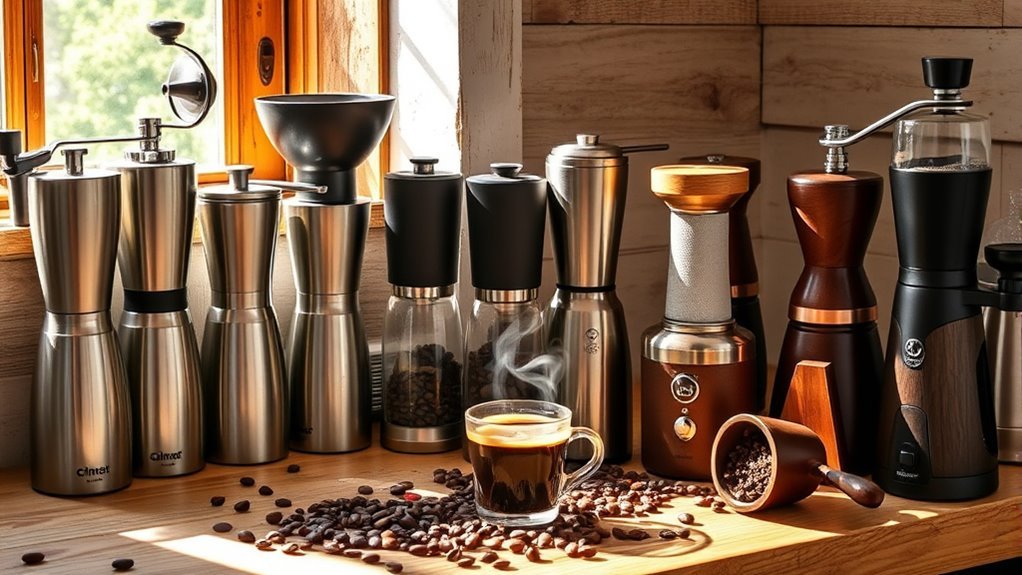
Although you might not realize it, the type of coffee grinder you choose greatly affects the grind consistency and, ultimately, the flavor extraction. When deciding between burr versus blade grinders, consider that burr grinders crush beans between two abrasive surfaces, delivering uniform particle size essential for balanced extraction. Blade grinders, in contrast, chop beans irregularly with a spinning blade, yielding inconsistent particle sizes that can compromise flavor. Additionally, burr grinders typically operate with less grinder noise, allowing you more freedom to grind without disturbing your environment. Blade grinders tend to be louder and less precise. Selecting a burr grinder is ideal if you seek consistent, controlled grinds with minimal noise, empowering you to fine-tune your brew with precision and maintain coffee’s full flavor potential.
Matching Grinder Types to Brewing Methods
Now that you understand how burr and blade grinders impact grind consistency and noise levels, it’s important to contemplate how different grind sizes align with specific brewing methods. Your choice of grinder should allow precise control over grind size to maintain ideal brewing consistency. Burr grinders excel here, providing uniform particles essential for methods like espresso and pour-over, while blade grinders offer less control, better suited for French press or drip.
| Brewing Method | Recommended Grind Size | Ideal Grinder Type |
|---|---|---|
| Espresso | Fine | Burr (Flat/Conical) |
| Pour-over | Medium-Fine | Burr (Conical) |
| Drip Coffee | Medium | Burr or Blade |
| French Press | Coarse | Burr or Blade |
| Cold Brew | Very Coarse | Burr |
Choose a grinder that matches your brewing style to promote freedom in flavor extraction and brewing consistency.
Key Features to Look for in a Coffee Grinder
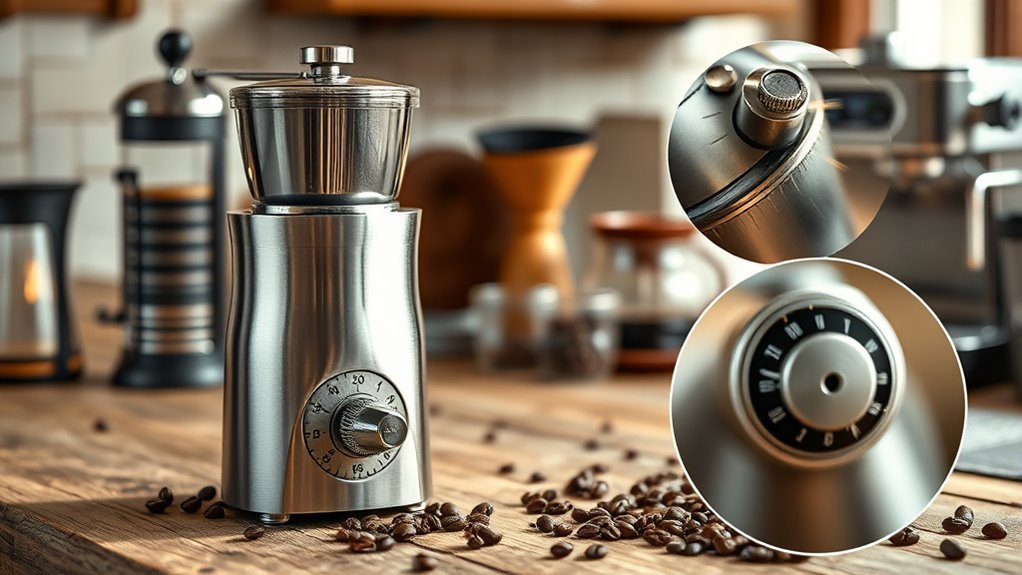
Selecting the right coffee grinder requires careful evaluation of several key features that directly affect grind quality, consistency, and overall user experience. First, focus on burr quality; high-grade steel or ceramic burrs provide precise, uniform particle size, which is vital for consistent extraction and flavor clarity. Next, assess grind consistency—look for grinders with minimal fines and uniform particle distribution to avoid uneven brewing. Adjustable grind settings are essential, allowing you to tailor grind size accurately for your preferred brewing method. Pay attention to motor power and speed control, as lower RPMs reduce heat buildup, preserving bean integrity. Finally, consider hopper capacity and ease of cleaning, ensuring the grinder supports your lifestyle without compromising freedom or convenience. These features collectively enhance your control over the brewing process.
Budget Considerations and Grinder Durability
While quality is paramount, your budget inevitably shapes the range of grinders you can consider. Grinder price varies widely, reflecting materials, motor strength, and precision engineering. Investing in a higher-priced grinder often means enhanced durability factors like hardened steel burrs and robust housing, which resist wear and maintain grind consistency over time. Conversely, lower-cost models may compromise on these aspects, leading to faster blade dulling or motor burnout. You should assess how much use your grinder will endure—frequent grinding demands superior build quality to justify the initial expense. Prioritize grinders with replaceable parts and solid warranties to extend lifespan and maintain performance. By aligning your budget with durability factors, you guarantee your grinder supports your brewing freedom without frequent replacements or degraded grind quality.
Tips for Maintaining and Cleaning Your Grinder
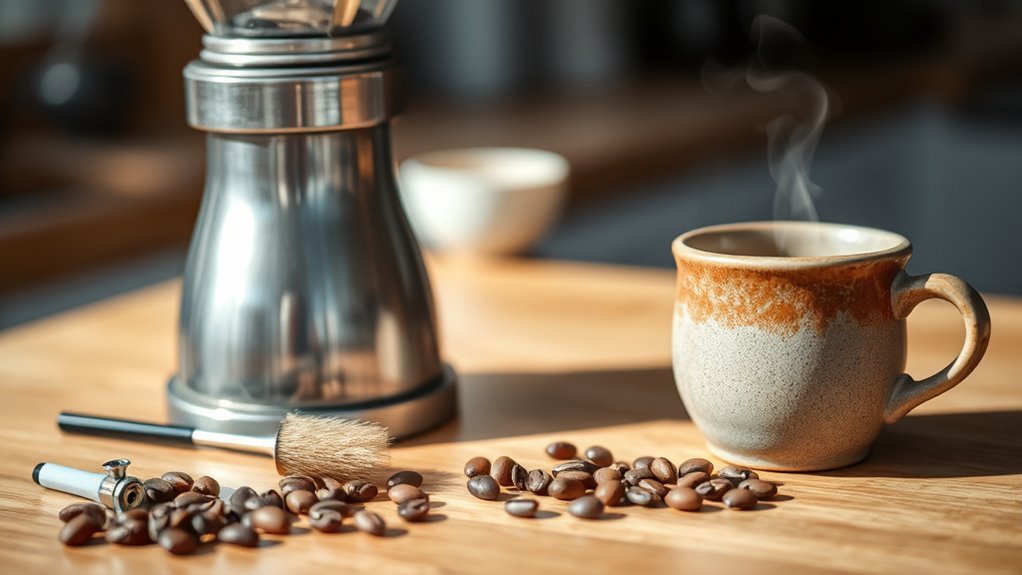
Ensuring your grinder maintains peak performance requires regular maintenance and cleaning, especially if you’ve invested in a durable model designed for frequent use. Proper grinder cleaning extends its lifespan and preserves grind consistency, essential for flavor accuracy. Follow these maintenance tips:
- Disassemble and Clean Burrs Weekly: Remove the burrs and brush away residual coffee grounds to prevent buildup that can alter grind size.
- Use Grinder-Specific Cleaning Pellets Monthly: These pellets absorb oils and dislodge trapped particles without damaging the burrs.
- Wipe External Surfaces After Each Use: Prevents dust and oils from accumulating, ensuring smooth operation.
Adhering to these steps gives you control over your grinder’s precision and reliability, empowering your brewing freedom with consistently fresh grounds.
Frequently Asked Questions
Can a Coffee Grinder Affect the Flavor of My Coffee?
Yes, a coffee grinder can greatly affect your coffee’s flavor. Different grind types—coarse, medium, fine—impact extraction rates, altering flavor profiles. A burr grinder offers consistent particle size, preserving nuanced flavors, while a blade grinder may produce uneven grinds, leading to bitterness or sourness. By choosing the right grinder, you control extraction precision, revealing the full potential of your beans and tailoring your brew to your taste preferences with freedom and accuracy.
How Does Grind Size Consistency Impact Brewing?
Did you know that up to 30% of your coffee’s extraction can be lost due to inconsistent grind size? When your grind size isn’t uniform, brewing efficiency drops because water extracts flavors unevenly. This means some grounds over-extract, becoming bitter, while others under-extract, tasting sour or weak. By ensuring consistent grind size, you gain precise control over extraction, revealing balanced flavors and maximizing the freedom to craft coffee just how you like it.
Are There Any Noise Differences Between Burr and Blade Grinders?
You’ll notice burr grinders generally produce lower noise levels compared to blade grinders, thanks to their slower, more uniform grinding action. Blade grinders tend to be louder due to high-speed blades chopping beans unevenly. Keep in mind, proper grinder maintenance—like regular cleaning—helps reduce noise over time by preventing buildup that strains the motor. So, if minimizing noise is essential for your freedom to grind anytime, burr grinders might be your best bet.
Can I Use a Grinder for Spices as Well?
Ever wondered if that coffee grinder can double as a spice grinder? While some grinders offer spice grinder compatibility, you should be cautious about flavor transfer concerns. Residual oils from spices can cling to burrs or blades, altering the taste of your coffee. If you want to use one grinder for both, thorough cleaning is essential, but for pure flavor freedom, a dedicated spice grinder might be your best bet.
How Long Does It Take to Grind Coffee Beans?
The grind time depends largely on your grinder type and the bean type you’re using. For example, harder beans like dark roasts may take slightly longer to grind than lighter roasts. Burr grinders typically take 15-30 seconds to produce a consistent grind, while blade grinders are faster but less uniform, often under 10 seconds. Adjust grind time to match your desired coarseness, ensuring you don’t overheat the beans or produce uneven grounds.