
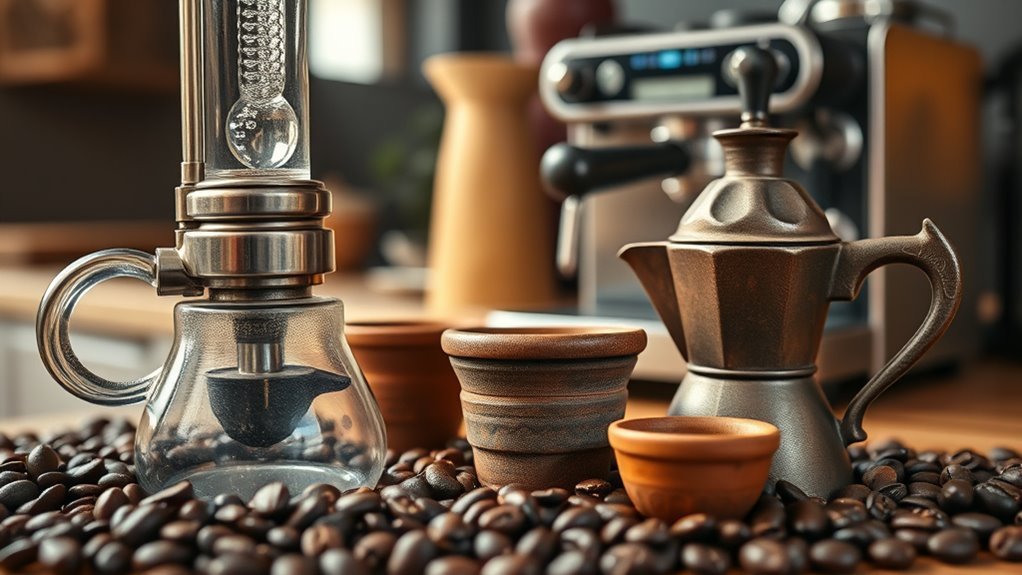
The History of Coffee Brewing: From Ancient Rituals to Modern Machines
You’d find coffee’s journey fascinating—starting in ancient Ethiopia with ritualistic use of coffee cherries, spreading through Middle Eastern coffeehouses as social hubs, then reaching Europe where coffee sparked intellectual revolutions. Over time, innovations like pour-over and espresso refined brewing, while industrialization introduced consistency but challenged tradition. Modern machines now blend precision with customization, reshaping how you experience coffee. Exploring further reveals how these layers of history, culture, and technology interconnect to form today’s vibrant coffee world.
Origins of Coffee in Ancient Civilizations
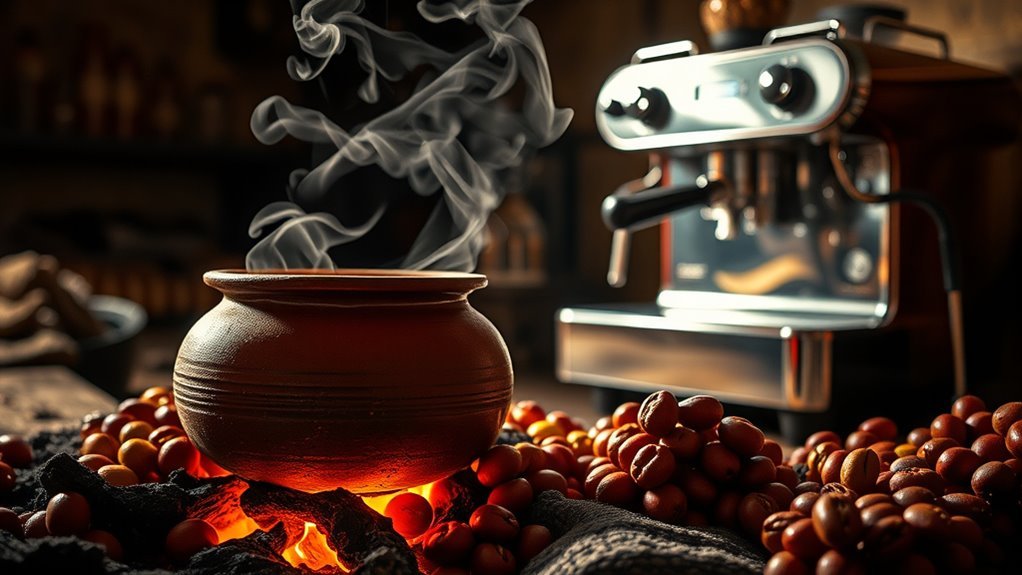
Although the exact origins of coffee remain partly shrouded in legend, its roots trace back to ancient civilizations in the Ethiopian highlands, where early communities first discovered the energizing effects of coffee cherries. According to Ethiopian legend, a goat herder named Kaldi observed his goats’ heightened vigor after consuming these cherries, sparking initial curiosity about coffee’s potential. You can appreciate how this natural discovery was more than chance—it was a catalyst for cultural transformation. Arab traders later recognized coffee’s value, facilitating its movement beyond Ethiopia while preserving its mystique. Their role wasn’t just commercial; they acted as custodians of coffee’s early identity. Understanding these origins offers you a glimpse into how freedom of exploration and exchange shaped coffee’s journey before it became the global ritual you know today.
The Spread of Coffee Brewing in the Middle East
As coffee brewing took hold in the Middle East, you’ll notice early coffeehouses quickly became hubs of social interaction and intellectual exchange. These spaces weren’t just about drinking coffee—they shaped cultural and religious practices, influencing daily life across the region. Understanding this expansion helps you grasp how coffee transformed from a simple beverage into a powerful cultural symbol.
Early Coffeehouses Emergence
When coffee began to capture the imagination of Middle Eastern societies in the 15th century, it wasn’t just the beverage itself that spread, but a new social institution: the coffeehouse. You’d find these spaces designed with distinct coffeehouse architecture—open layouts encouraging social gathering, conversation, and intellectual exchange. They became hubs where freedom of thought subtly flourished, fostering community bonds beyond mere consumption.
| Feature | Description | Purpose |
|---|---|---|
| Open Seating | Cushions and low tables | Promote accessibility & talk |
| Central Hearth | Fire pit or stove | Warmth and brewing |
| Decorative Tiles | Intricate geometric patterns | Cultural identity |
| Courtyards | Outdoor communal areas | Social interaction |
| Windowed Facades | Allow light and visibility | Transparency, openness |
Understanding this architecture helps you grasp how early coffeehouses empowered social freedom through design.
Cultural Significance Expansion
The emergence of coffeehouses not only redefined social spaces but also paved the way for coffee’s wider cultural integration across the Middle East. You’ll see how coffee transcended mere beverage status, embedding itself into cultural rituals and social gatherings. This expansion wasn’t accidental; it reflected evolving societal values and freedoms. Consider these aspects:
- Coffeehouses as hubs for intellectual exchange and political discourse
- Ritualistic preparation and serving methods reinforcing community bonds
- Integration of coffee into religious and cultural ceremonies
- Promotion of social equality by welcoming diverse social classes
- Influence on art, literature, and music through shared experiences
Coffee in Europe: From Curiosity to Culture
When you explore Europe’s early coffeehouses, you’ll notice they quickly became hubs for intellectual exchange and social interaction. This shift transformed coffee from a mere exotic curiosity into an integral part of daily life and culture. Understanding this evolution reveals how coffee shaped European society beyond just a beverage.
Early European Coffeehouses
Coffeehouses quickly became more than just places to drink; they transformed into hubs of social interaction, intellectual exchange, and cultural development across Europe. When you step into an early European coffeehouse, you’re entering a space where coffeehouse culture forged new social dynamics. These venues nurtured lively social gatherings that challenged traditional norms and encouraged free thought. You’d find:
- Philosophers debating revolutionary ideas
- Merchants exchanging crucial information
- Artists sharing creative inspirations
- Political discussions shaping public opinion
- Writers composing groundbreaking works
This environment wasn’t just about coffee; it was about freedom—freedom to converse openly, question authority, and build communities beyond rigid social structures. Understanding these early coffeehouses reveals how they seeded modern European cultural and intellectual life by linking the simple act of drinking coffee to profound social transformation.
Coffee’s Cultural Integration
As you trace coffee’s journey through Europe, you’ll notice how it evolved from a mere curiosity to an integral part of social fabric and daily life. Initially exotic, coffee quickly inspired new coffee rituals that shaped how people connected. These rituals weren’t just about drinking; they fostered social gatherings where ideas, politics, and culture mingled freely, reflecting evolving societal values. Coffeehouses became hubs of intellectual exchange, democratizing access to knowledge and encouraging individual expression. You’ll see how coffee’s integration mirrored Europe’s thirst for freedom—breaking traditional barriers in social interaction. By embracing coffee, Europeans didn’t just adopt a beverage; they cultivated a culture where community and conversation thrived, illustrating how a simple drink can transform collective identity and everyday experience.
Innovations in Coffee Brewing Techniques
Although traditional methods laid the foundation for brewing, innovations in coffee techniques have dramatically transformed how you experience flavor and aroma. Embracing coffee chemistry and brewing experiments, you now reveal complex profiles from single origin beans like never before. The rise of coffee gadgets such as the Aeropress method and pour over have put precision and control at your fingertips, enhancing flavor extraction. Cold brew revolutionizes your palate with smooth, low-acid coffee, while sustainable brewing practices align your passion with environmental responsibility. Regional styles inspire your brewing choices, encouraging exploration beyond conventional methods.
Innovative coffee techniques unlock rich flavors and aromas, blending tradition with precision and sustainability for a truly unique brew experience.
- Precision pour over for clarity and nuance
- Aeropress method offering versatility and speed
- Cold brew’s smooth, bold profile
- Coffee gadgets enhancing extraction control
- Sustainable brewing supporting ethical choices
These innovations empower your freedom to craft coffee uniquely suited to your taste.
The Rise of Espresso and Coffeehouses
The evolution of brewing techniques paved the way for espresso to become a defining element in coffee culture. You’ll notice how espresso culture transformed coffee rituals, emphasizing speed and intensity without sacrificing flavor complexity. Originating in early 20th-century Italy, espresso machines allowed you to extract coffee under high pressure, creating a concentrated shot that redefined your daily coffee experience. Coffeehouses emerged as social hubs where espresso wasn’t just a drink but a catalyst for conversation, creativity, and community. These spaces fostered a newfound appreciation for coffee’s sensory richness and ritualistic preparation, empowering you to engage freely with your beverage and surroundings. In embracing espresso and coffeehouses, you participate in a dynamic tradition that balances innovation with the communal essence of coffee rituals.
The Impact of Industrialization on Coffee Brewing
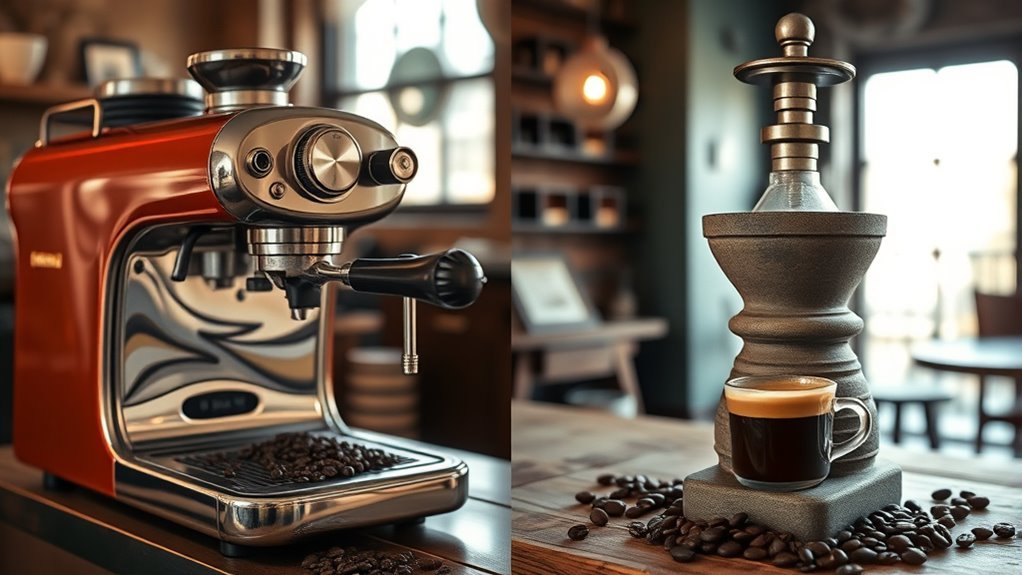
When industrialization reshaped global production, it fundamentally altered how you approach coffee brewing. The introduction of industrial machinery revolutionized coffee production, making it faster and more consistent, yet it also distanced you from traditional, artisanal methods. You gained access to mass-produced coffee, but at the cost of some individuality in the brewing process.
Industrialization made coffee brewing faster and consistent, but less personal and artisanal.
Consider these key impacts:
- Mechanization increased coffee output, meeting growing demand.
- Standardization guaranteed uniform grind sizes and roasting.
- Accessibility to coffee expanded beyond elite circles.
- Early industrial machines began automating brewing steps.
- Industrialization fostered global coffee trade networks.
This shift empowered you with convenience and availability, yet challenged you to retain the freedom to customize and savor coffee’s rich heritage amid mass production.
Modern Coffee Machines and Brewing Technology
As technology has advanced, you’ve seen modern coffee machines transform brewing from a manual art into a precise science. Today’s smart brewers leverage sensors and algorithms to control variables like water temperature, pressure, and grind size with remarkable accuracy. This automated extraction process guarantees consistency, allowing you to enjoy café-quality coffee without mastering complex techniques. These machines adapt to your preferences, offering customization while freeing you from repetitive tasks. The integration of IoT technology means you can start brewing remotely, aligning with your lifestyle’s demand for convenience and autonomy. By blending tradition with innovation, modern coffee technology empowers you to craft each cup with precision and freedom, reflecting a shift from labor-intensive methods to intelligent systems designed to enhance your daily ritual.
Frequently Asked Questions
How Does Coffee Brewing Affect Caffeine Content?
Imagine the rich aroma swirling as hot water meets coffee grounds—your brewing method shapes caffeine’s journey. If you use a long extraction time, like in a French press, caffeine seeps out fully, giving you a robust kick. Quick methods, like espresso, extract caffeine rapidly but in smaller volumes. So, your choice in brewing method and extraction time directly impacts how much caffeine energizes your day, letting you savor freedom in every cup.
What Is the Environmental Impact of Coffee Production?
When you consider the environmental impact of coffee production, you’ll find deforestation effects are significant, as forests are cleared for coffee farms, harming biodiversity and soil health. However, sustainable farming practices can help you reduce this damage by promoting shade-grown coffee and organic methods. By supporting these, you’re not just enjoying your brew—you’re also protecting ecosystems and encouraging a freer, more responsible relationship between agriculture and the environment.
How Do Different Coffee Bean Varieties Influence Flavor?
Flavorful facets fascinate you when comparing Arabica vs. Robusta beans. Arabica offers a sweeter, softer flavor with hints of fruit and sugar, while Robusta packs a stronger, harsher taste with nutty and chocolatey notes. Understanding these flavor profiles helps you choose coffee that fits your freedom to explore taste. Each variety’s growing conditions and processing influence complexity, so you can savor a brew that truly suits your personal palate and preferences.
What Are the Health Benefits of Drinking Coffee?
When you drink coffee, you tap into its powerful antioxidant properties that help protect your cells from damage. This means you’re not just enjoying a tasty beverage; you’re supporting your body’s defenses. Plus, coffee boosts mental alertness, sharpening your focus and helping you stay energized throughout the day. By choosing coffee, you embrace a natural way to enhance both your physical health and cognitive performance, giving you the freedom to tackle your goals with clarity.
How Should Coffee Be Stored for Freshness?
Imagine a specialty café in Seattle that keeps their beans in airtight containers away from light to preserve flavor. You should apply similar coffee storage methods at home to maintain freshness. Key freshness tips include storing coffee in a cool, dark place, using opaque, airtight containers, and avoiding moisture. By controlling these factors, you’ll extend your coffee’s shelf life and enjoy a richer, more vibrant cup every time.