

The History and Origins of Coffee
You’ll find coffee’s history begins with the legend of Kaldi, an Ethiopian goat herder who noticed his goats’ energy after eating coffee berries. Cultivated first in Ethiopia and Yemen, coffee gained spiritual and social importance in Islamic culture, spreading through Ottoman trade routes. Coffeehouses emerged as hubs for intellectual and social exchange, eventually reaching Europe and the Americas, where cultivation and industrialization transformed global trade and culture. Exploring further reveals coffee’s profound role in shaping societies and economies worldwide.
The Legend of Kaldi and the Discovery of Coffee

Although the story of Kaldi and his dancing goats is often regarded as a myth, it provides a fascinating starting point for understanding how coffee was first discovered. You can analyze how Kaldi’s goats, after consuming certain red berries, exhibited unusual energy and movement. This observation led Kaldi to investigate the source—the mystical beans on the coffee plant. While the narrative lacks empirical evidence, it symbolically captures human curiosity about natural stimulants. The tale emphasizes the initial recognition of coffee’s energizing properties, which would later fuel sociocultural and economic developments. By considering Kaldi’s goats as a metaphor, you appreciate how early encounters with coffee’s effects sparked interest and experimentation. This legend, though not historically verified, frames coffee’s origin in a way that resonates with those valuing exploration and freedom of discovery.
Early Cultivation and Spread in Ethiopia and Yemen
You’ll find that coffee’s early cultivation began in Ethiopia, where local tribes first recognized its stimulating properties. From there, the beans traveled along Yemeni trade routes, which played an essential role in spreading coffee beyond its origin. Understanding these connections helps explain how coffee shifted from a regional curiosity to an international commodity.
Ethiopian Coffee Beginnings
Coffee’s origins trace back to the highlands of Ethiopia, where early cultivation practices laid the foundation for its global significance. When you explore Ethiopian coffee beginnings, you notice how deeply intertwined coffee is with cultural identity through Ethiopian rituals and coffee ceremonies. These ceremonies aren’t just social events; they signify respect, community, and freedom of expression.
Consider these key aspects:
- Wild coffee plants thrived naturally, prompting indigenous groups to harvest and experiment with cultivation.
- Ethiopian rituals incorporated coffee as a spiritual and social element, reinforcing its cultural importance.
- The structured coffee ceremonies formalized preparation and consumption, reflecting values of hospitality and connection.
Understanding these factors offers insight into coffee’s initial role beyond a mere beverage—it’s a symbol of heritage and liberation.
Yemeni Trade Routes
Trade routes between Ethiopia and Yemen played an essential role in transforming coffee from a localized crop into a commodity with far-reaching influence. Yemeni geography, characterized by rugged mountains and strategic ports along the Red Sea, created natural pathways for the movement of goods. These routes facilitated the early cultivation and dissemination of coffee beyond its Ethiopian origins. Coffee caravans traversed these challenging terrains, connecting remote growing areas to burgeoning markets. By moving coffee through these established channels, traders enabled the crop’s integration into Arabian culture and commerce. You can see how these networks not only spread coffee but also embedded it within trade systems critical to regional economies. Understanding this dynamic helps you appreciate coffee’s transformation into a global phenomenon that champions freedom in trade and cultural exchange.
The Role of Coffee in Islamic Culture

You’ll find that coffee emerged as more than just a beverage within Islamic culture, gaining religious and social importance. It played a key role in spiritual practices by enhancing alertness during long prayers and discussions. Understanding this context helps explain how coffeehouses became centers for intellectual exchange and community bonding.
Coffee’s Emergence in Islam
Although the origins of coffee trace back to Ethiopia, its integration into Islamic culture during the 15th century profoundly shaped its global significance. You’ll notice that coffee became more than just a beverage; it evolved into a symbol deeply embedded in cultural and spiritual practices. Key factors include:
- Sufi rituals and mystical experiences, where coffee’s stimulating properties supported extended religious devotion and meditation.
- Islamic scholars who debated coffee symbolism, influencing its acceptance and role within religious frameworks.
- Trade networks and cultural exchange that spread coffee across Islamic societies, embedding it into culinary practices and religious gatherings.
This integration not only facilitated coffee’s dissemination but also established its identity as a catalyst for intellectual and spiritual engagement within Islamic culture.
Religious and Social Significance
When you explore the religious and social roles of coffee in Islamic culture, it becomes clear that the beverage served purposes far beyond mere refreshment. Coffee became integrated into ritualistic practices, often accompanying prayers and spiritual reflection, symbolizing alertness and devotion. You’ll notice how coffeehouses functioned as hubs for community gatherings, fostering dialogue and intellectual exchange, which supported cultural exchanges across diverse Islamic societies. These venues were essential for social cohesion, enabling people to engage in discussions that transcended class and background. The spiritual symbolism of coffee linked it to heightened consciousness, reinforcing its acceptance within religious frameworks. Understanding coffee’s role in Islamic culture reveals how it acted as a catalyst for both communal unity and the spread of ideas, aligning with values of freedom and collective engagement.
Coffee’s Journey to the Ottoman Empire
As coffee spread beyond its Ethiopian and Yemeni origins, its arrival in the Ottoman Empire marked a pivotal moment in its global history. You’ll find that the Ottoman coffeehouses became central to social and intellectual life, shaping public discourse and culture. The coffee trade routes through the empire facilitated this expansion, connecting diverse regions.
- The Ottoman Empire’s strategic position controlled key trade routes, allowing coffee to flow from Yemen to Istanbul efficiently.
- Ottoman coffeehouses emerged as inclusive spaces, fostering dialogue and community, reflecting a growing demand for both the beverage and social interaction.
- The empire’s governance and infrastructure supported coffee’s integration, balancing regulation with accessibility.
Understanding these elements highlights how coffee’s journey within the Ottoman domain contributed considerably to its worldwide proliferation.
The Emergence of Coffeehouses in the Middle East
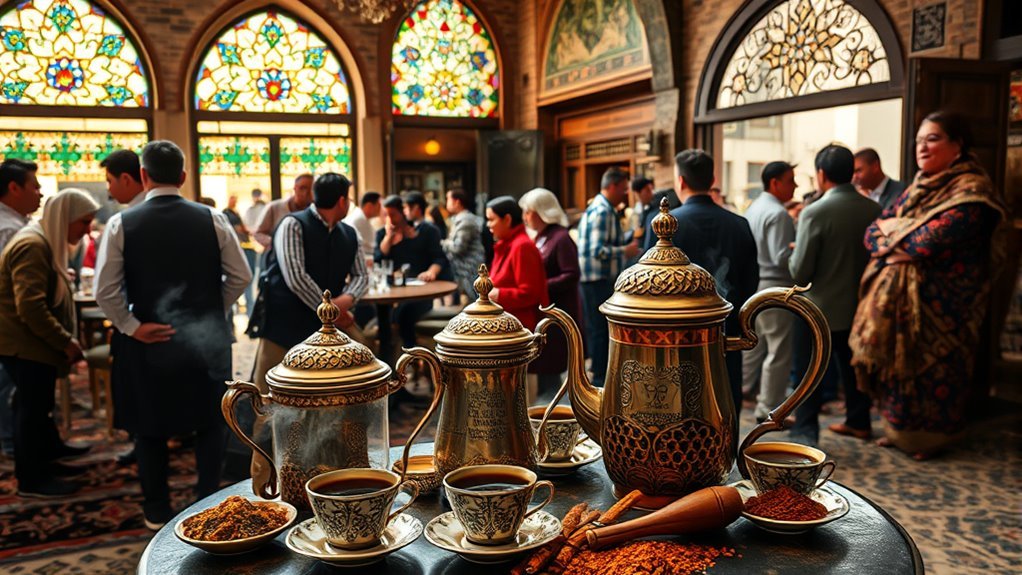
When coffeehouses first appeared in the Middle East, they quickly became more than just places to enjoy a drink. You’ll find they served as essential social hubs where ideas were exchanged, and community bonds were strengthened. Understanding this early coffeehouse culture reveals how these establishments shaped social interactions and public discourse.
Early Coffeehouse Culture
Although coffee’s origins trace back to Ethiopia, it was in the Middle East that coffeehouses first emerged as influential social hubs. These establishments became centers of cultural exchange, where you’d experience more than just a beverage. Understanding early coffeehouse culture involves three key aspects:
- Coffeehouse etiquette: You’d quickly notice strict social norms governing behavior, ensuring respect and order during conversations and gatherings.
- Cultural gatherings: These venues hosted poets, musicians, and intellectuals, fostering dynamic exchanges of ideas and art.
- Accessibility: Coffeehouses were open to a diverse public, allowing you to engage freely with different social classes and viewpoints.
Social Role in Society
Since coffeehouses first appeared in the Middle East, they’ve played a significant social role by shaping public discourse and community interaction. You can see how these spaces fostered social gatherings where individuals from different backgrounds engaged in dialogue, exchanging ideas freely. Coffee rituals within these establishments went beyond mere consumption; they structured the rhythm of daily life and encouraged a culture of attentive listening and thoughtful conversation. By providing a neutral ground, coffeehouses became hubs of intellectual exchange, challenging established authorities and promoting social mobility. If you value freedom, you’d appreciate how these venues contributed to the emergence of civic society, enabling citizens to discuss politics, culture, and philosophy openly. Ultimately, coffeehouses helped cultivate a public sphere essential for societal progress and collective awareness.
Introduction of Coffee to Europe
As coffee made its way from the Ottoman Empire to European ports in the 17th century, its introduction sparked both curiosity and controversy across the continent. You’d notice that the burgeoning coffee trade wasn’t just about a new beverage; it was a catalyst for a broader European awakening. Here’s what you should consider:
- Economic Impact: Coffee trade routes established new commercial opportunities, challenging existing monopolies and fostering global connections.
- Cultural Reception: Initial skepticism gave way to acceptance as coffee symbolized modernity and intellectual engagement.
- Regulatory Responses: Authorities debated coffee’s effects, reflecting tensions between tradition and innovation.
Understanding these factors helps you appreciate how coffee evolved from an exotic import to a staple influencing European thought and society.
The Rise of Coffeehouses in Europe and Their Social Impact
When coffeehouses began to proliferate across Europe in the 17th century, they quickly became more than just places to enjoy a beverage; they emerged as essential social hubs that shaped public discourse and community life. You’d find that coffeehouse culture fostered open social gatherings where ideas about politics, philosophy, and commerce circulated freely, promoting intellectual exchange and democratic engagement.
| Aspect | Impact |
|---|---|
| Accessibility | Open to diverse social classes |
| Intellectual Hub | Encouraged debate and spread of ideas |
| Commercial Role | Facilitated business networking |
| Cultural Influence | Influenced literature, art, and politics |
Coffee Cultivation Expands to the Americas
The expansion of coffeehouses across Europe created a growing demand that quickly extended beyond the continent’s borders, prompting the spread of coffee cultivation to the Americas. As you explore this phase, consider how:
- Agricultural techniques adapted to new climates, enhancing crop diversity and fostering resilient plantation systems that fueled economic impact.
- Trade networks expanded, linking the Americas to global markets, which intensified cultural exchange but also complicated labor practices on plantations.
- Coffee cultivation became a catalyst for both opportunity and challenge, shaping societies through shifts in economic power and social structures.
Industrialization and the Coffee Trade
Although coffee cultivation had already transformed global agriculture, industrialization accelerated its trade by introducing mechanized processing and improved transportation. You’ll find that advancements such as steam-powered mills and railways dramatically increased coffee production efficiency, reducing costs and expanding market reach. This shift reshaped the coffee economy, allowing producers to meet growing international demand swiftly. As you examine this period, notice how mechanization enabled large-scale plantations to thrive, concentrating production in key regions. Additionally, enhanced shipping routes guaranteed fresher beans arrived faster, stabilizing supply chains. Understanding these changes reveals how industrialization not only boosted output but also integrated coffee into global commerce more deeply. If you value freedom, recognizing this evolution highlights the interplay between technology and economic liberation within the coffee trade.
Coffee’s Influence on Modern Society and Culture
Industrialization’s impact on coffee production and trade set the stage for its profound role in shaping modern society and culture. When you explore coffee’s influence, consider how it intertwines with cultural rituals and societal norms, reinforcing community bonds. Its integration into daily routines and social gatherings highlights its role beyond mere consumption. Additionally, coffee’s significance extends to the global economy and evolving beverage trends, reflecting shifts in market demands and preferences. You can break down coffee’s influence into three key areas:
- Cultural rituals and artistic expressions that celebrate coffee’s heritage.
- Influence on societal norms through shared daily consumption and social rituals.
- Economic impact within the global economy, driving innovation and health benefits awareness.
Understanding these facets helps you appreciate coffee’s multifaceted role in your life.
Frequently Asked Questions
What Are the Main Chemical Compounds in Coffee?
When you drink coffee, you’re engaging with several key chemical compounds. The primary one is caffeine, responsible for the stimulating effects you feel, known as caffeine effects. Additionally, coffee aroma comes from volatile oils and organic acids, which give coffee its distinct smell and flavor complexity. Understanding these compounds helps you appreciate how coffee influences your mind and senses, granting you the freedom to tailor your experience according to your preferences.
How Does Coffee Affect Human Health?
When you drink coffee, caffeine benefits include improved alertness, focus, and even a lower risk of certain diseases like Parkinson’s and type 2 diabetes. However, you should also consider health risks: excessive caffeine can cause anxiety, insomnia, and increased heart rate. Moderation is key, so you can enjoy coffee’s perks without negative effects, giving you the freedom to tailor your intake based on your own body’s responses.
What Are the Different Coffee Brewing Methods?
You might think brewing techniques are complicated, but they actually empower you to tailor your coffee experience. From drip coffee makers and French press to espresso machines and pour-over setups, each coffee equipment type extracts unique flavors and strengths. Understanding these methods lets you control grind size, water temperature, and brew time, offering freedom to craft your perfect cup. Exploring different techniques enhances your appreciation and enjoyment of coffee’s rich complexity.
How Is Coffee Graded and Classified?
When you explore coffee grading, you’ll find classification systems focus on factors like bean size, shape, color, and defects. These systems objectively assess quality, allowing you to choose coffee that fits your taste and values. You’ll encounter grades such as specialty, premium, and commercial, each with specific criteria. By understanding these classifications, you gain the freedom to select coffee aligned with your preferences and standards, ensuring a satisfying and informed choice.
What Environmental Impacts Does Coffee Farming Have?
When it comes to coffee farming, you’re often walking a tightrope between production and environmental harm. The deforestation effects are significant, as clearing land for coffee plantations strips away essential trees, leading to soil erosion and disrupted water cycles. This, in turn, causes biodiversity loss, reducing habitat for countless species. If you want to enjoy your brew freely, understanding these impacts helps you support more sustainable practices, balancing nature’s delicate dance.